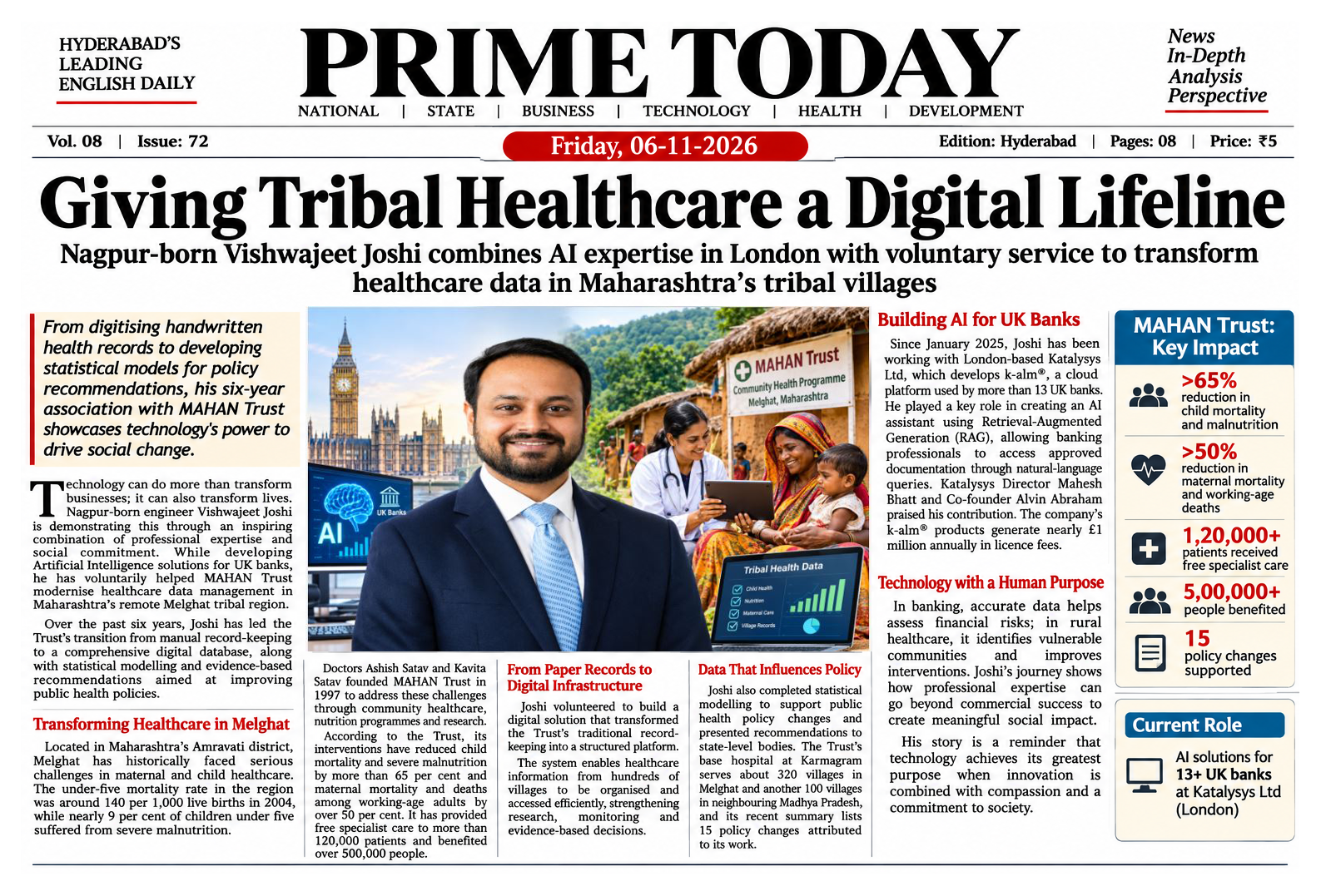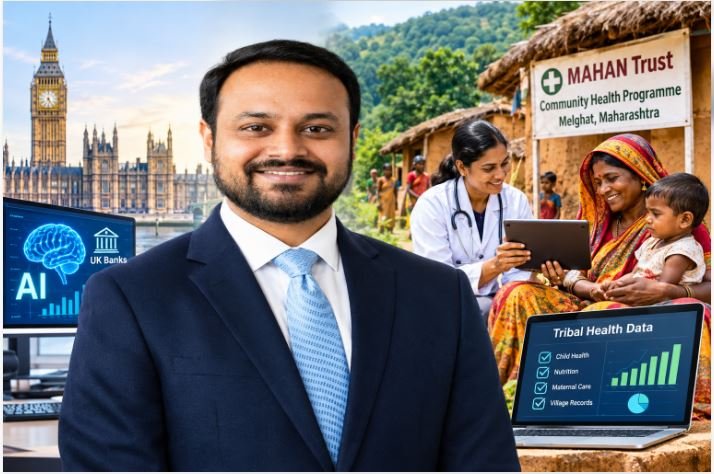
Nagpur-born Vishwajeet Joshi combines AI expertise in London with voluntary service to transform healthcare data in Maharashtra’s tribal villages
From digitising handwritten health records to developing statistical models for policy recommendations, his six-year association with MAHAN Trust showcases technology’s power to drive social change.
Technology can do more than transform businesses; it can also transform lives. Nagpur-born engineer Vishwajeet Joshi is demonstrating this through an inspiring combination of professional expertise and social commitment. While developing Artificial Intelligence solutions for UK banks, he has voluntarily helped MAHAN Trust modernise healthcare data management in Maharashtra’s remote Melghat tribal region. Over the past six years, Joshi has led the Trust’s transition from manual record-keeping to a comprehensive digital database. His contribution also includes statistical modelling and evidence-based recommendations aimed at improving public health policies.
Transforming Healthcare in Melghat
Located in Maharashtra’s Amravati district, Melghat has historically faced serious challenges in maternal and child healthcare. According to MAHAN Trust, the under-five mortality rate in the region was around 140 per 1,000 live births in 2004, while nearly nine per cent of children under five suffered from severe malnutrition.
Doctors Ashish Satav and Kavita Satav founded MAHAN Trust in 1997 to address these challenges through community healthcare, nutrition programmes and research.
According to the Trust, its interventions have reduced child mortality and severe malnutrition by more than 65 per cent and maternal mortality and deaths among working-age adults by over 50 per cent. It has provided free specialist healthcare to more than 120,000 patients and benefited over 500,000 people.
From Paper Records to Digital Infrastructure Managing healthcare information across hundreds of remote villages was once a major challenge for the organisation. Most records were collected manually, making data retrieval, research and analysis time-consuming.
Recognising the need for technological intervention, Joshi volunteered to build a digital solution. He designed the database infrastructure that transformed the Trust’s traditional record-keeping system into a structured digital platform.
The new system enables healthcare information collected from villages to be organised, maintained and accessed efficiently. It has also strengthened the Trust’s ability to conduct research, monitor health trends and make evidence-based decisions.
Data That Influences Policy Joshi’s contribution extends beyond digitalisation. He completed statistical modelling to support proposed public health policy changes and presented recommendations to stakeholders across several state-level bodies.
According to the Trust’s 2017 summary, its base hospital at Karmagram serves approximately 320 villages in Melghat and another 100 villages in neighbouring Madhya Pradesh.
The Trust’s recent summary lists 15 policy changes attributed to its work. Reliable digital records and statistical analysis help strengthen the evidence behind such recommendations and support discussions with policymakers.
Building AI for UK Banks
Since January 2025, Joshi has been working with London-based Katalysys Ltd, which develops k-alm®, a cloud-based platform used by more than 13 UK banks for stress testing, funds transfer pricing and interest rate risk analysis.
At the company, he played a central role in developing an AI assistant using Retrieval-Augmented Generation (RAG). The system allows banking professionals to interact with approved documentation through natural-language queries.
Its role-based access controls ensure that users receive information according to their authorised responsibilities. For example, a regulatory reporting manager can access detailed explanations of regulations, while a Chief Financial Officer receives a concise summary of their business implications.
Katalysys Director Mahesh Bhatt praised Joshi’s contribution to developing the AI chatbot. Co-founder and Director Alvin Abraham also appreciated his practical knowledge of AI and its implementation.
The company’s k-alm® products generate nearly £1 million annually in licence fees.
Technology with a Human Purpose Although developing AI solutions for international banks and supporting healthcare in tribal villages may seem like two different worlds, both depend on one essential principle: reliable data leads to better decisions.
In banking, accurate information helps institutions assess financial risks. In rural healthcare, it helps identify vulnerable communities, evaluate medical interventions and recommend policy improvements.
Joshi’s journey demonstrates how professional expertise can extend beyond commercial success to create meaningful social impact. While contributing to London’s advanced AI industry, he continues to support healthcare initiatives in some of India’s most underserved communities.
His story is a reminder that technology achieves its greatest purpose when innovation is combined with compassion and a commitment to society.