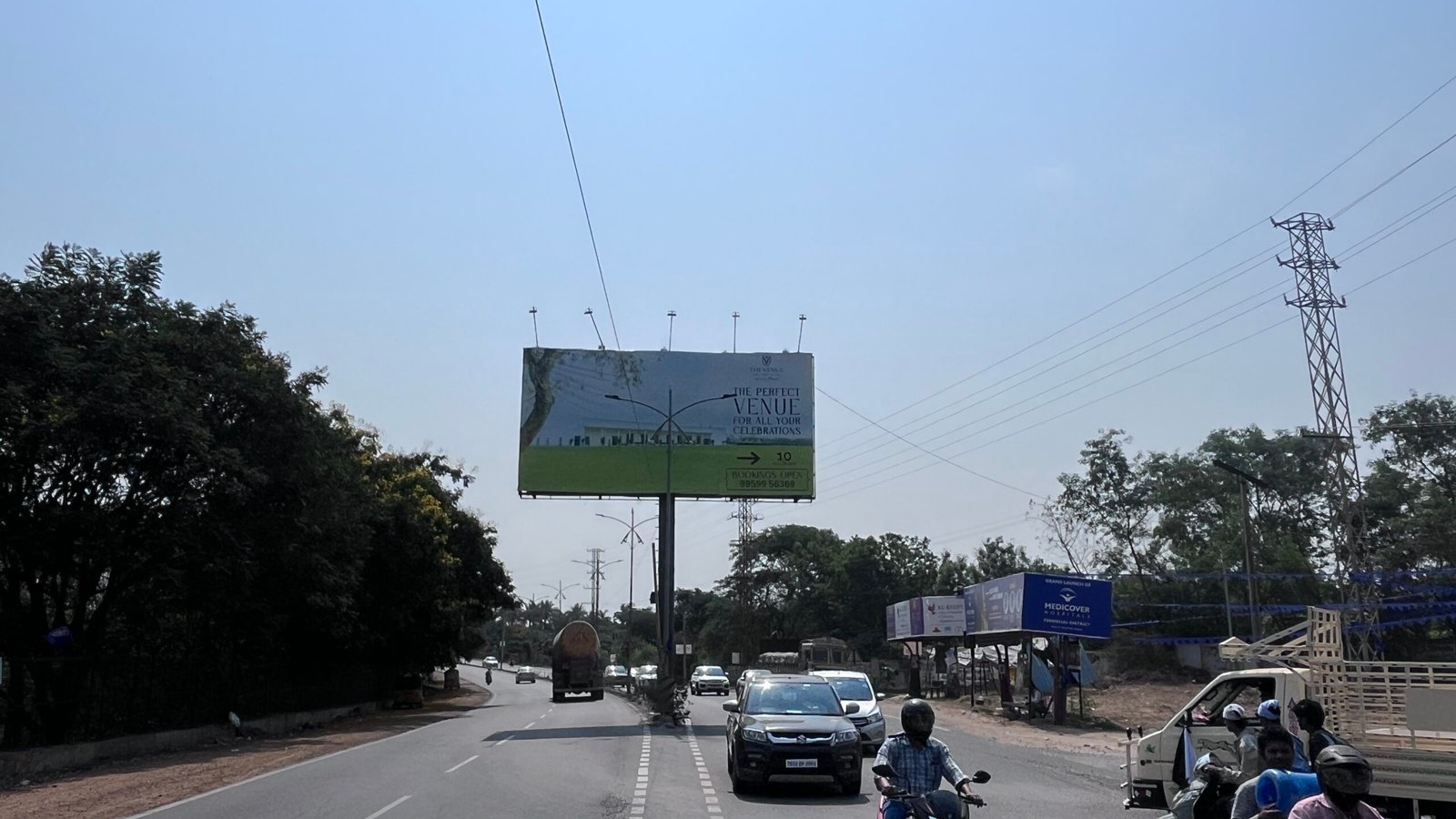
- Despite a nationwide ban on commercial advertisements within National Highway Right of Way, dozens of T-poles and large-format hoardings continue to occupy the central median of NH-163 from Appa Junction to Chevella — with authorities conducting road widening visits yet failing to enforce the law.
NH-163, which runs through the western outskirts of Hyderabad into Ranga Reddy district, was originally designated a State Highway before being formally recognised and operationally integrated into the National Highway network around 2012. Since then, responsibility for the corridor — including the enforcement of land use, access controls, and safety norms — has rested with the National Highways Authority of India (NHAI) under the jurisdiction of MoRTH.
The highway has been under active road widening and upgradation work for several years, a project plagued by delays. Recent months have seen the work pick up pace, with NHAI officials reportedly conducting frequent on-site visits. Yet, sources say, not a single large format illegal hoarding on the median has been removed.
“I nearly missed an accident because of the huge advertisement board right in the middle of the road. My eyes went to it for just a second and I had to brake hard.”
— A commuter on NH-163, speaking to PrimetodayTV
Multiple drivers using the route told PrimetodayTV that large-format hoardings on the central median regularly distract them from the road ahead — especially at busy intersections and village-edge junctions where vehicle interactions are more complex. One driver recounted narrowly avoiding a collision after his attention was drawn to an oversized advertisement panel rising from the median near Aziz Nagar.
“These boards serve no public interest. They make money for private companies while putting everyone on this road at risk,” said another commuter who travels the stretch daily. “The NHAI people come here for road widening work. How do they not see these poles? It makes you wonder.”
The legal position on commercial hoardings within National Highway RoW is unambiguous. MoRTH policy explicitly prohibits all advertisement hoardings on National Highways and Expressways within the Right of Way. The central median, being an integral part of the RoW, is squarely covered by this prohibition.
Applicable legal provisions
- Rule 11 read with Rule 5, Control of National Highways (Land and Traffic) Rules, 2002: Any advertisement structure within National Highway land — including the central median — is prohibited unless expressly permitted by the Highway Administration.
- MoRTH Guidelines: Commercial hoardings within the RoW are impermissible in practice.
- IRC:46 and IRC:67 (Indian Roads Congress): Prohibit distracting advertisements near carriageways, intersections, and medians; mandate a clear zone free of obstructions.
- NHAI Policy: Treats hoardings in the RoW and median as encroachments and road safety hazards.
Commercial formats explicitly barred within the RoW include T-poles, unipoles, lollipop signs, and digital billboards. The structures identified on NH-163 fall directly under these categories. IRC guidelines further emphasise that median structures violate the clear zone norms essential for safe stopping and recovery distances, while simultaneously creating driver distraction conditions that dramatically increase crash risk.
What makes the situation particularly alarming is that the illegal hoardings have persisted even as active construction supervision is underway on the same stretch. NHAI officials have been present on-site regularly in connection with the ongoing widening project. Despite their physical presence and legal authority to treat these structures as encroachments on National Highway land, enforcement action appear to have been initiated.
Private companies erecting hoardings on the median are, in effect, profiting commercially from public infrastructure — earning revenues estimated in crores annually from the high-visibility median placements — while assuming zero cost or liability for the safety hazard created. This constitutes an unauthorised commercial exploitation of government land, in addition to being a clear road safety violation.
Civil society groups and highway safety advocates have long called for a proactive enforcement drive on urban and peri-urban National Highway stretches where commercial interests have quietly encroached on median land over the years. The situation on NH-163 is a textbook case: a legally prohibited encroachment, a documented driver distraction and safety hazard, and a government agency actively present on the ground yet failing to act.
Residents and commuters using the route have urged NHAI and MoRTH to immediately survey and identify all illegal structures on the median between Appa Junction and Chevella, issue formal demolition orders, and ensure that the ongoing road widening project restores the full legal RoW — free of commercial encroachments. Until then, every commuter on NH-163 takes on a risk that the law says they should never have to face.