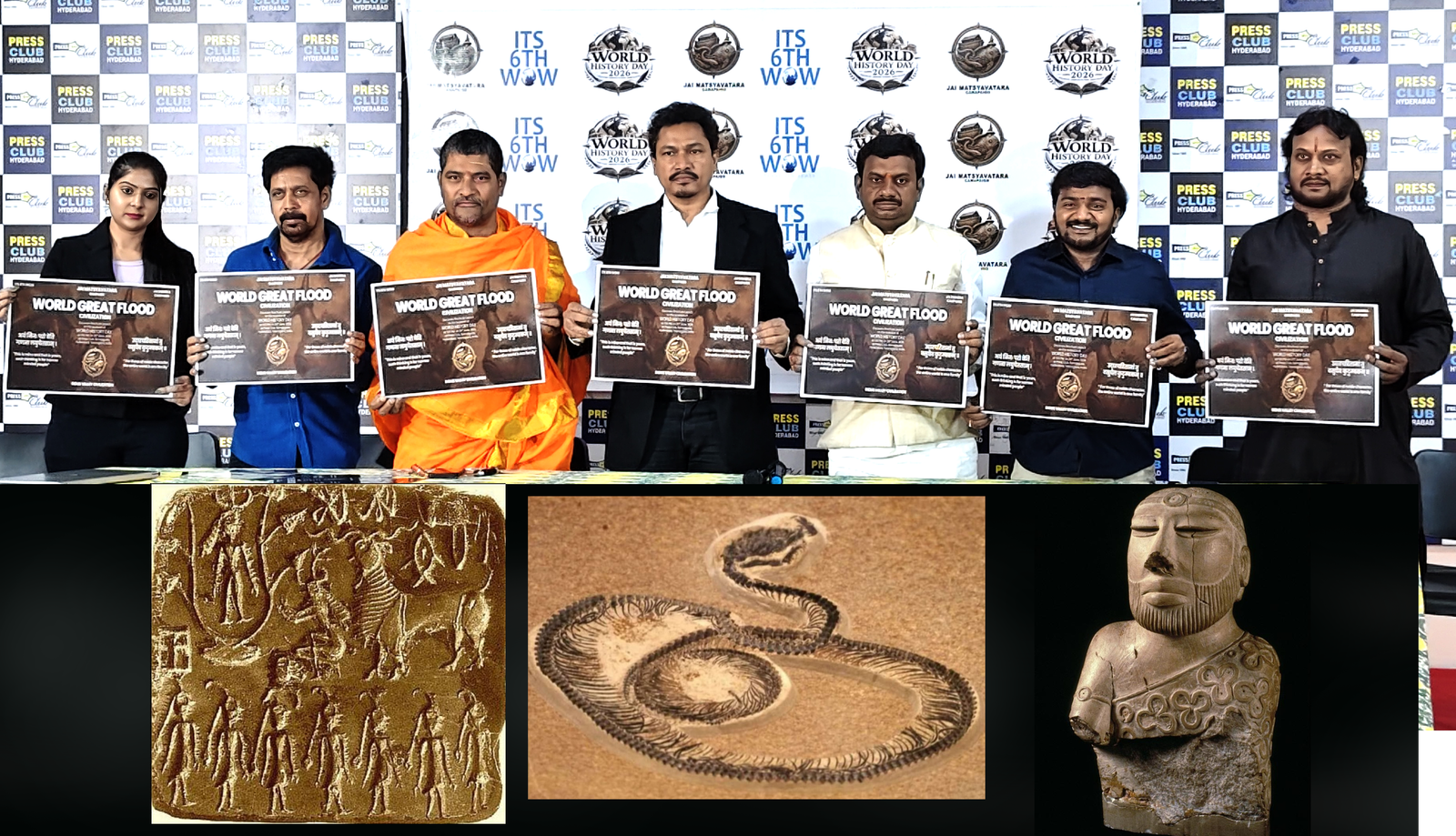
Hyderabad: Marking World History Day 2026, Hyderabad-based organization ITS 6TH WOW, under the banner of the Jai Matsyavatara Campaign, unveiled a thought-provoking research presentation titled “The World Great Flood Civilization – Matsyavatara Civilization” at the Hyderabad Press Club.
The presentation, conceptualized and developed by Ravindrajith, General Secretary of ITS 6TH WOW, proposes a multidisciplinary research framework that explores possible cultural, archaeological and civilizational connections between the Indus Valley Civilization and ancient global flood traditions preserved across different cultures.
Rather than presenting definitive historical conclusions, the study describes itself as a research hypothesis intended to encourage scholarly discussion, scientific evaluation and interdisciplinary investigation.
A New Perspective on Ancient Civilizations
The presentation examines whether ancient flood narratives associated with Manu, Noah, Nuh, Utnapishtim, Ziusudra, Deucalion, and other legendary figures may preserve shared cultural memories that could be explored through archaeology, comparative mythology, ancient literature and environmental evidence.
According to the presentation, these narratives share recurring themes such as divine warning, preservation of life, construction of an ark, survival of a catastrophic flood, post-flood settlement and thanksgiving traditions.
Seven Pillars of the Proposed Framework
The research introduces a seven-point analytical model for studying what it describes as the proposed World Great Flood Civilization:
The Chosen Saviour
The Saviour City
The Ark City
The Seven Wise Men
The Seven Wise Men Cities
The Landing Site
Sacrifice and Thanksgiving Tradition
The authors suggest that these themes provide a common framework for examining flood traditions preserved across multiple ancient civilizations.
Dholavira Proposed as the ‘Saviour City’
One of the presentation’s key propositions identifies Dholavira, in present-day Gujarat, as a possible administrative, water-management and knowledge-preservation centre within the proposed framework.
Its advanced hydraulic engineering, sophisticated urban planning and strategic geographical location are cited as reasons for further academic investigation.
Lothal and Ancient Maritime Heritage
The research also revisits the archaeological significance of Lothal, home to one of the world’s earliest known dockyards.
It proposes that Lothal may have played an important role in ancient maritime preservation efforts associated with flood traditions, while emphasizing that this remains a subject for future archaeological research.
Matsyavatara and the Indus Valley Civilization
Among the most notable ideas presented is the interpretation of the fish motif, frequently found on Indus seals, pottery and artifacts.
The presentation proposes that the recurring fish symbol may represent a preserved cultural memory associated with the Matsyavatara tradition, in which humanity is warned of an impending flood and life is safeguarded from destruction.
Based on this interpretation, the researchers introduce the conceptual term “Matsyavatara Civilization” as a possible framework for future academic exploration.
Comparative Study of Global Great Flood Traditions
The presentation draws comparisons between flood narratives preserved in Vedic, Mesopotamian, Biblical, Islamic, Persian, Greek and several other ancient traditions.
It identifies recurring motifs including divine intervention, flood survival, preservation of living beings, sacred vessels, post-flood migration and thanksgiving rituals.
Call for Scientific Collaboration
ITS 6TH WOW emphasized that the concept of the Matsyavatara Civilization is a research proposal rather than an established historical conclusion.
The organization invited archaeologists, historians, epigraphists, marine archaeologists, geologists, paleoclimatologists, Sanskrit scholars, artificial intelligence researchers and other academic experts to scientifically evaluate, test, challenge and expand the proposed framework through evidence-based research.
Suggested Areas for Future Research
The presentation recommends further investigation in several interdisciplinary fields, including:
Decipherment of the Indus script
Fish and maritime symbolism in Harappan archaeology
Geological evidence of ancient flood deposits
Maritime technology and dockyard studies at Lothal
Water management systems of Dholavira
Comparative analysis of global flood traditions
Archaeological and geological correlations
Cultural continuity between the Harappan civilization and later Indian traditions
Ravindrajith’s Statement
Addressing the gathering, Ravindrajith, General Secretary of ITS 6TH WOW, said:
“The Matsyavatara Civilization framework seeks to initiate a new dialogue between archaeology, ancient literature, cultural memory and global flood traditions. Our objective is not to claim final answers, but to encourage collaborative research into one of humanity’s most enduring narratives—the survival, preservation and continuity of civilization.”
Dignitaries Present
The press conference was attended by Vijay, Chairman of HRC Council Telangana; Dr. Chinta Rukmangada Rao, noted Tantra Astrology scholar; Sri Sri Suresh Atmaram Guruji; Kishore Kumar Pulla, International Chairman of ITS 6TH WOW; Srinivas Reddy Kondakindi, India Chairman; Kaladhar Vallam, Telangana Chairman; Jahnavi Sahithi, President; Kranthi Kumar, Vice President; Ravindrajith, General Secretary; Founder, Jai Matsyavatara Campaign members Manish and Ankanna, Kishore, Dharma Sthapana.
The event concluded with an appeal for greater international collaboration in exploring ancient civilizations through archaeology, history, environmental science and emerging technologies.