Mahipal Reddy Vuppula
- Weaving the Future — From Nizam-era silk markets to global fashion runways, Telangana bets big on textiles to power its trillion-dollar dream.
- Thread of Ambition — Chief Minister Revanth Reddy charts a bold course to make Telangana the fabric capital of South Asia by 2047, with heritage, infrastructure, and global partnerships as its warp and weft.
- Cotton to Couture — With a mega textile park in Warangal, green hubs in the pipeline, and a direct line to Milan and Tokyo, Telangana is stitching together its most ambitious industrial vision yet.
- The Loom of a New Economy — At ATEXCON 2026, Telangana declared its centuries-old weaving DNA the foundation of a $3 trillion future — and invited the world to spin it together.
- Draped in Destiny — As Pochampalli Ikat and Gadwal sarees meet global fashion capitals, Telangana’s Chief Minister calls on investors to join a textile revolution rooted in culture and driven by policy.
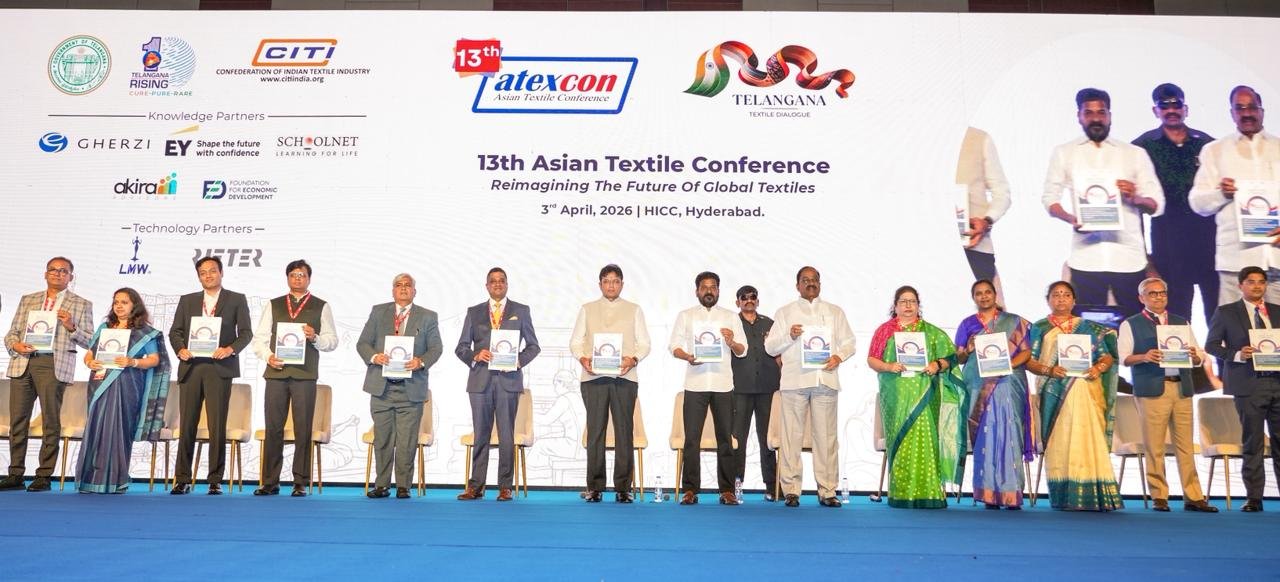
Hyderabad: Chief Minister A. Revanth Reddy set a sweeping vision for Telangana’s future at the 13th Asia Textile Conference (ATEXCON 2026), declaring that the state will emerge as the foremost textile capital in South Asia by 2047. Organised jointly by the state government and the Confederation of Indian Textile Industry (CITI) in Hyderabad on 14–15 November 2026, the conference drew government officials alongside national and international representatives from the textile sector.
At the event, Revanth Reddy released the Atosikan-2026 report and toured a textile exhibition, accompanied by state ministers. His address was at once a history lesson, a policy pitch, and a direct appeal to industrialists to make Telangana the loom of the world.
“Textile is not just a sector in Telangana. It is the livelihood of people. Our goal is to make every country in the world wear clothes made in Telangana.”
— Chief Minister A. Revanth Reddy, ATEXCON 2026
A heritage woven into the state’s identity
Revanth Reddy traced Telangana’s textile story back centuries, pointing to the Nizam era when traders from across the world converged on Hyderabad to purchase its famed fabrics and pearls. “Textiles are part of our DNA,” he said, arguing that the state’s deep cultural roots in weaving give it an organic advantage that no policy alone can manufacture.
India’s standing as a quality textile producer stretches back millennia, he noted, shaped by art, tradition, and craftsmanship passed down through generations. Telangana, as one of the country’s leading cotton producers with globally recognised fibre quality, sits at the heart of that legacy.
A trillion-dollar trajectory: TelanganaRising2047
The textile push is embedded within the state’s broader economic roadmap, branded TelanganaRising2047. Revanth Reddy outlined a two-stage target: a $1 trillion economy by 2034, scaling to $3 trillion by 2047. Textiles, he made clear, will be a central pillar of that growth story — not a peripheral industry.
Infrastructure, incentives, and investor ease
The government has already moved beyond rhetoric. A world-class mega textile park has been established in Warangal, under the aegis of the historic Kakatiya region. The park hosts multiple specialised zones designed to attract the full spectrum of the value chain — from spinning and weaving to finishing and export.
For new investors, the Chief Minister listed a compelling set of facilitations: subsidised land, reliable electricity and water supply, and an accelerated single-window clearance system for all necessary permits. “We follow policies aligned with global competition,” he said, adding that Telangana’s skilled human resource pool further sharpens its competitive edge.
“We are collaborating on many aspects, from Telangana cotton fields to London, New York, Paris, Milan, Tokyo, and Dubai fashion shows. If you have a vision, we will be the perfect partners.”
— Chief Minister A. Revanth Reddy
From cotton fields to global catwalks
One of the more striking passages of the Chief Minister’s address was his explicit connection of Telangana’s raw cotton fields to the world’s top fashion capitals — London, New York, Paris, Milan, Tokyo, and Dubai. It was a signal that the state’s ambition is not merely to be a manufacturing hub but to embed itself in the entire global fashion value chain, from fibre to finished couture.
He also drew an intriguing parallel with Hyderabad’s burgeoning film industry. The city, he noted, is fast becoming a cinema capital not just for India but for the world. With major Tollywood and Bollywood productions already anchored in Hyderabad — and Hollywood increasingly following suit — the CM sees fashion as a natural co-industry. “The film industry will encourage the development of their fashion from Telangana itself,” he said, framing the two sectors as mutually reinforcing growth engines.
Green textiles and inclusive growth
Sustainability featured prominently in the government’s vision. Revanth Reddy pledged to develop dedicated green textile hubs, signalling that environmental conservation is not an afterthought but a foundational design principle of the state’s industrial policy
The CM also underscored the human dimension of the plan, committing to skilling programmes targeted especially at women — positioning them as key drivers of the textile economy. He spoke of blending traditional design intelligence with modern tools across design, cutting, and stitching, ensuring that artisanal knowledge is not displaced but amplified by technology.
A call to build together
Closing his address, the Chief Minister framed Telangana not as a petitioner seeking investment but as an equal partner in a shared endeavour. “Telangana is not the only state. We are a successful partnership,” he said. He urged industrialists, designers, and global brands to co-create a textile ecosystem that could, in his own words, “transform the world.”
The ATEXCON 2026 conference, with its blend of national heritage pride and forward-looking industrial policy, positioned Telangana as a state that is serious — institutionally, infrastructurally, and ideologically — about reclaiming its place at the centre of global textiles.